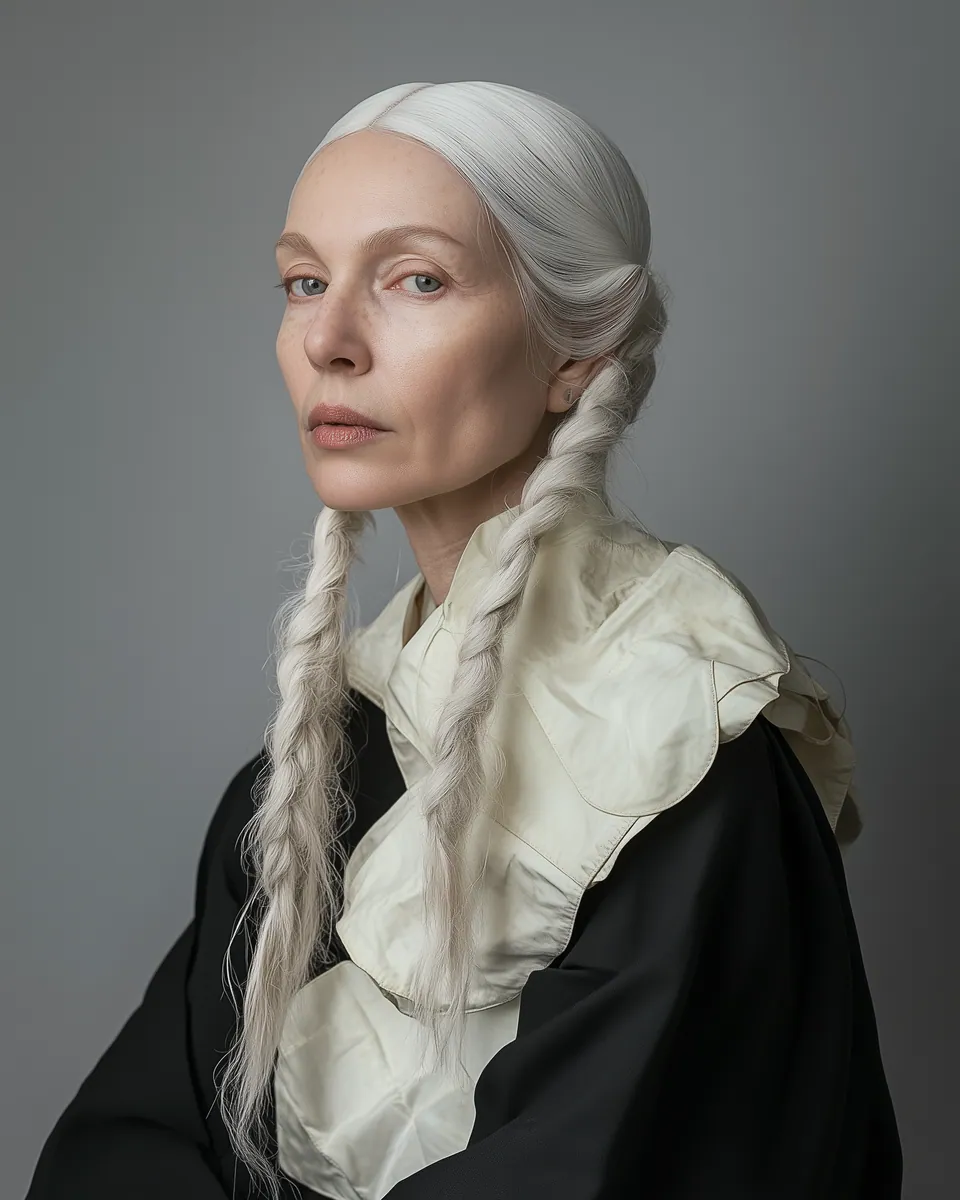
Intermundia2024
Between worlds: Artemisia in Leonardo’s landscapes.
Portraits from the Artemisia series, reworked by an artificial intelligence trained on them, inhabit landscapes inspired by Leonardo da Vinci. Augmented reality enters the work for the first time: seen through a device, each piece expands beyond its surface.
Installation views
Critical text
Intermundia is a point of intersection between epochs, languages, and realities—a liminal space "between worlds" where painting, photography, and artificial intelligence engage in dialogue. Here, the echoes of tradition reverberate through the filter of digital media, while technology redefines the very concept of representation.
At the core of the project lies Artemisia, a photographic series created in the studio by Matteo Basilé, which forms the genetic architecture of this new phase of his work. The images from Artemisia were processed through artificial intelligence, trained on these very portraits to learn and replicate the original visual language, transposing human figures into a new aesthetic dimension. AI does not merely generate images ex nihilo; rather, it amplifies and reinterprets the photographic matrix, preserving its physicality and narrative strength.
Layered onto this foundation are backdrops inspired by Leonardo da Vinci’s landscapes, digitally reworked into timeless scenarios—landscapes of a collective memory that are reactivated and transfigured. The dialogue between figure and background, between portrait and environment, is never static: the women of Intermundia emerge from a painterly limbo that envelops them, suspended between reality and abstraction, between flesh and pixel.
For the first time, Basilé introduces a phygital dimension to Intermundia, where the boundary between the image and the viewer dissolves through augmented reality. The artwork is no longer a fixed entity but a form in transformation: through AR, the portrait expands beyond its surface and comes to life through the screen of a device. Augmented reality thus becomes a perceptual threshold, a portal through which the artwork manifests itself in new forms, revealing hidden layers and turning the observer into an active participant in the artistic process.
The visual manifesto of Intermundia is an experience in which the body, the landscape, and technology merge into an indivisible whole. Artificial intelligence is not merely a tool but a narrative component that reinterprets the past without erasing it, instead amplifying its symbolic value. In this context, contemporary art questions itself, as Arthur Danto suggested, arguing that art is not merely the product of a technique or medium but the result of a process of reflection on its own essence. The artwork thus becomes a device that expands the very concept of representation, positioning itself as a threshold between the real and the virtual.
Here, Basilé does not simply reference Leonardo; rather, he reactivates his genetic code, expanding it through new media. The concept of hybridization takes center stage, echoing the ideas of N. Katherine Hayles, who asserts that the digital realm does not supplant the corporeal but extends it—a new language through which to translate reality.
In this hybrid space, the portrait is no longer merely a representation but a pulsating organism, capable of evolving and interacting. The phygital dimension of Intermundia marks a crucial shift in contemporary visual research, where art becomes a domain of experience, connection, and continuous transformation. As Joan Fontcuberta, a pioneer in integrating artificial intelligence into photographic practice, has observed, AI represents a new frontier for expanding the visual language, offering unprecedented possibilities for creativity and perception.
With Intermundia, Matteo Basilé redefines the very concept of portraiture, transforming it into a sensory and technological experience, where the past is never a constraint but rather an opportunity to envision new worlds.
Next chapter
Lumen et Ombra
2025
Light is the portrait. Shadow, its hidden fate.
Enter